Author: Pengcheng(Frank) Shi,Leyu Zhu,Sihan Meng
Affiliation: RSBM
Email: pengchengshi@biotechrs.com; pcspc9@gmail.com
Abstract
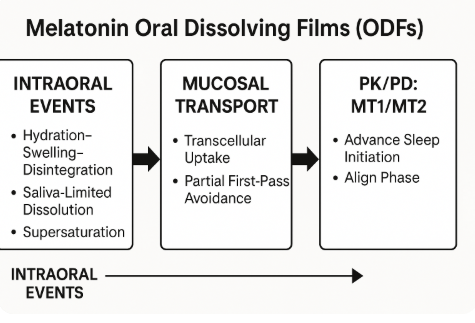
Melatonin ODFs are designed for rapid sleep-onset support by coupling fast intraoral disintegration with buccal/sublingual absorption and circadian-targeted pharmacodynamics at MT1/MT2 receptors. Performance arises from (i) hydration–swelling–disintegration of the polymer matrix; (ii) saliva-limited dissolution with short-term supersaturation control; (iii) transcellular-dominant mucosal transport that partly bypasses first-pass metabolism; and (iv) receptor-level effects that advance sleep initiation and align phase. Mechanism-based formulation levers include polymer blends, plasticizer level, solid-state control (amorphous/co-amorphous), cyclodextrin or polymeric solubilization, optional mucoadhesion, and multilayer unidirectional designs. A QbD path and IVIVC-ready test cascade are outlined. [1–10]
Keywords: melatonin; oral dissolving film; buccal delivery; dissolution kinetics; MT1/MT2; supersaturation
1. Introduction
Melatonin is a small, moderately lipophilic, highly permeable indole amide used to reduce sleep-onset latency and to shift circadian phase. ODFs are attractive when rapid onset, dose flexibility (0.3–5 mg), and dysphagia-friendliness are desired. Compared with swallow tablets/capsules, ODFs can shorten (T_{\text{max}}) through mucosal uptake and lower variability linked to gastric emptying and first-pass metabolism. [2–5]
2. Physicochemical Basis
Melatonin shows low aqueous solubility but high permeability and remains largely unionized across salivary pH (≈6.2–7.4), favoring transcellular diffusion. Rate-limiting steps for ODFs therefore often shift to dissolution into limited saliva and maintenance of a brief supersaturated state before absorption. [1,3,6,9]
3. Intraoral Events
3.1 Hydration–Swelling–Disintegration
Hydrophilic film-forming polymer blends (e.g., HPMC/PVA/PVP/pullulan) hydrate quickly; plasticizers (glycerol, propylene glycol, sorbitol) lower (T_g) to enable chain mobility and disintegration within ~10–30 s under typical oral shear. Thickness, porosity, and surface energy govern wetting and effective area. [1–3]
3.2 Dissolution and Mass Transfer
Drug release follows Noyes–Whitney: (\mathrm{d}C/\mathrm{d}t=(DA/h)(C_s-C)). Nonionic surfactants and cyclodextrins increase (C_s) and wetting; amorphous solid dispersions (ASDs) or co-amorphous systems enlarge apparent (D) and sustain short-term supersaturation; tongue/cheek motion reduces (h). A practical target is (T_{80%}\le 120) s in saliva-limited tests. [3,6,9]
4. Mucosal Transport
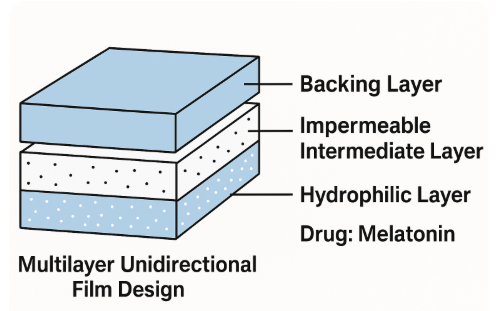
Sublingual/buccal epithelia permit transcellular-dominant diffusion for unionized melatonin; paracellular flux is tight-junction limited. Optional permeation enhancers (fatty acids, bile salts) may raise flux but must be balanced against local tolerability; short exposure and nonionic systems are preferred. Multilayer ODFs (mucoadhesive/drug/backing) enable unidirectional release toward the mucosa and reduce swallow loss. [4–7]
5. Pharmacokinetics and Chronopharmacology
By combining fast dissolution with mucosal uptake and partial first-pass avoidance, melatonin ODFs can reach earlier (T_{\text{max}}) and comparable or higher AUC vs. swallow forms at the same nominal dose. Clinically, the objective is to advance sleep initiation with minimal next-day residual effects; timing relative to the dim-light melatonin onset (commonly ~30–60 min pre-bedtime) is important. Semi-mechanistic or PBPK models that incorporate salivary dilution, swallow fraction, and mucosal fraction support IVIVC and labeling. [2,4,5,8,10]
6. Pharmacodynamics: MT1/MT2
Melatonin activates MT1 (facilitates sleep initiation via SCN neuronal inhibition) and MT2 (phase-shifting/entrainment) receptors. Rapid attainment of effective concentrations in mucosal capillaries translates into shorter sleep-onset latency and phase advancement when dosed appropriately. Palatable taste and mouthfeel improve adherence and thus PD outcomes. [2,5]
7. Formulation and Process Strategy
Polymer matrix: HPMC/PVA/PVP/pullulan blends to balance toughness with fast disintegration; plasticizer 15–30% (w/w of polymer) while avoiding tack/migration via drying profile and aging control. [1–3]
Solubilization: ASDs or co-amorphous systems with PVP/VA or HPMC-AS; cyclodextrin inclusion; low-level nonionic surfactants plus anti-nucleation polymers to maintain short-term supersaturation. [3,6]
Mucoadhesion/unidirectionality: 0.1–0.5% chitosan or carbomer for residence; add a hydrophobic backing layer to bias flux toward mucosa. [4,7]
Structural engineering: micro-porosity 5–15%, thickness 40–120 μm, optional microchannels to increase capillary flow path. [1–3]
Packaging/stability: alu-laminate sachets, WVTR/OTR control to prevent moisture uptake, recrystallization, and strength loss. [1–3]
8. Test Cascade and IVIVC
Disintegration/dissolution in artificial saliva (37 °C, pH 6.8–7.0), report (T_{10%}) and (T_{80%}).
Solid-state monitoring (DSC/XRD/FTIR/Raman) for amorphous stability.
Mucoadhesion/permeation: ex vivo buccal tissue in Franz cells for flux and (P_{\text{app}}); TR146/HOK cell models with TEER to assess barrier effects and tolerability.
Pilot PK (sublingual/buccal) vs. reference tablet/solution; deconvolution to estimate mucosal vs. swallow fractions; link to semi-PBPK/IVIVC models. [2–5,7–10]
9. Safety and Acceptability
Use physiologic pH, nonionic surfactants, and minimal enhancer loads to limit irritation/burning. Manage potential bitterness rebound after supersaturation. Counsel to avoid concurrent alcohol or sedatives at bedtime that could potentiate CNS effects. [5–7]
10. Conclusions
Melatonin ODFs integrate saliva-limited dissolution, transcellular mucosal transport, and MT1/MT2 chronopharmacology to deliver rapid, predictable sleep benefits. Mechanism-driven formulation—solid-state control, short-term supersaturation management, and unidirectional mucoadhesive architectures—supports earlier (T_{\text{max}}), consistent exposure, and high patient acceptability. [1–6,8–10]
References
[1] Dixit RP, Puthli SP. Oral strip technology: overview and future potential. J Control Release. 2009.
[2] Preis M, Pein M, Breitkreutz J. Orodispersible films: a modern dosage form for pediatric use. J Pharm Pharmacol. 2014.
[3] Cilurzo F, Cupone IE, et al. Fast dissolving films: from bench to market. Drug Discov Today. 2011.
[4] Shojaei AH. Buccal mucosa as a route for systemic drug delivery: a review. J Pharm Pharm Sci. 1998.
[5] Hearnden V, Sankar V, et al. New developments and opportunities in oral mucosal drug delivery. Adv Drug Deliv Rev. 2012.
[6] Pein M, et al. Development of taste-masked orodispersible films. Eur J Pharm Biopharm. 2014.
[7] Thabet Y, et al. In vitro and in vivo evaluation of mucoadhesive buccal films. Int J Pharm. 2011.
[8] ICH Q8(R2). Pharmaceutical Development. 2009.
[9] Noyes AA, Whitney WR. The rate of solution of solid substances in their own solutions. J Am Chem Soc. 1897.
[10] Lennernäs H. Human intestinal permeability. Clin Pharmacokinet. 1998.