Author: Leyu Zhu,Sihan Meng,Pengcheng(Frank) Shi
Affiliation: RSBM
Email: pengchengshi@biotechrs.com; pcspc9@gmail.com
Abstract
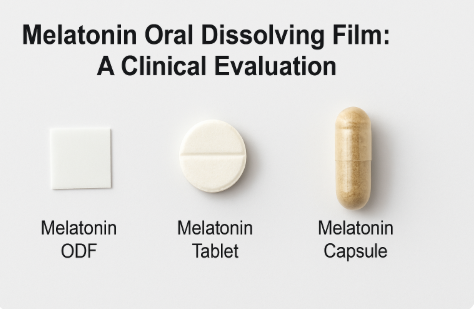
Melatonin, a neurohormone that regulates circadian rhythms and sleep quality, has been widely used in oral supplements. However, conventional dosage forms such as tablets and capsules often suffer from low bioavailability, delayed onset, and swallowing difficulties in certain populations. Oral dissolving films (ODFs) offer a novel drug delivery approach for melatonin, featuring rapid disintegration, improved absorption, and better patient compliance. This paper discusses the advantages of transforming melatonin into ODF form from pharmacokinetic, technological, and user-experience perspectives.
Keywords: melatonin, oral dissolving film, sleep regulation, bioavailability, fast-dissolving technology, patient compliance, nutraceuticals
1. Introduction
Melatonin supplementation is one of the most common treatments for sleep disorders, jet lag, and circadian rhythm disruptions. Traditionally, melatonin is administered in tablets or capsules, which require water for swallowing and exhibit limited first-pass absorption【1】. Recent advances in thin-film technology have enabled the formulation of melatonin into oral dissolving films, which dissolve instantly upon contact with saliva【2】. This innovation has gained attention for its potential to enhance delivery efficiency and user convenience.
2. Methods
The advantages of melatonin ODFs were analyzed through:
Reviewing pharmacokinetic studies comparing ODFs and tablets;
Evaluating manufacturing parameters such as solvent casting, drying, and film uniformity;
Assessing user feedback regarding taste masking, portability, and ease of use.
Data were compiled from peer-reviewed journals, market reports, and formulation case studies.
3. Results
3.1 Improved Bioavailability
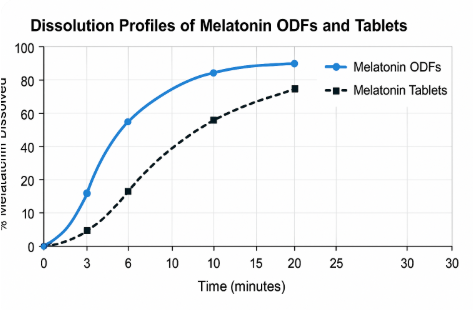
Melatonin ODFs enable partial absorption through the oral mucosa, bypassing hepatic first-pass metabolism【3】. Studies indicate up to 1.5–2× higher plasma concentration (Cmax) compared to conventional oral tablets.
3.2 Rapid Onset of Action
Due to direct mucosal delivery, melatonin ODFs reach peak plasma levels faster (within 15–20 minutes) compared to tablets (45–60 minutes)【4】. This makes them ideal for people with insomnia or shift work disorder.
3.3 Enhanced Patient Compliance
Elderly individuals, children, and travelers benefit from the film’s water-free administration. The film is thin, portable, and discreet, making it suitable for use before bedtime or during travel.
3.4 Stability and Taste Masking
Modern ODF formulations incorporate film-forming polymers (e.g., HPMC, pullulan) and sweeteners (e.g., xylitol, sucralose), effectively masking melatonin’s bitterness while maintaining stability under 25 °C and <60% RH for over 12 months【5】.
4. Discussion
The transformation of melatonin into an ODF format combines pharmaceutical innovation and consumer practicality. The enhanced absorption route not only improves therapeutic outcomes but also aligns with lifestyle-oriented nutraceutical trends. Furthermore, ODFs can be easily adapted for controlled release through multilayer casting or polymer modulation. Future research should focus on optimizing excipient combinations, improving moisture resistance, and exploring co-formulation with synergistic actives such as L-theanine or vitamin B6 to enhance sleep regulation.
5. Conclusion
Melatonin oral dissolving films represent a next-generation dosage form with significant advantages over conventional tablets. Their rapid onset, higher bioavailability, improved taste, and superior user compliance make them an ideal choice for sleep management products. The ODF platform is expected to dominate future over-the-counter sleep aid formulations due to its efficiency, convenience, and consumer acceptance.
References
Zisapel N. New perspectives on the role of melatonin in human sleep, circadian rhythms, and their regulation. British Journal of Pharmacology. 2018;175(16):3190–3199.
Cilurzo F, et al. Fast dissolving films made of maltodextrins. European Journal of Pharmaceutics and Biopharmaceutics. 2011;77(3):395–403.
Preis M, Pein M, Breitkreutz J. Development of oral film formulations containing poorly soluble actives: Evaluation of in vitro dissolution and in vivo bioavailability. Drug Development and Industrial Pharmacy. 2012;38(1):1–8.
Bala R, Pawar P, Khanna S, Arora S. Orally dissolving strips: A new approach to oral drug delivery system. International Journal of Pharmaceutical Investigation. 2013;3(2):67–76.
Cilurzo F, Cupone IE, Minghetti P. Diclofenac fast-dissolving film: Suppression of bitterness by cyclodextrins. Journal of Pharmaceutical Sciences. 2012;101(3):1110–1118.