Author: Sihan Meng, Leyu Zhu, Pengcheng Shi
Affiliation: RSBM
Email: pengchengshi@biotechrs.com; pcspc9@gmail.com
Abstract
Melatonin oral films represent a fast-onset, consumer-friendly alternative to conventional sleep aids such as tablets and capsules. By delivering melatonin through a rapidly dissolving film in the oral cavity, this dosage form enables quicker absorption, improved compliance, and a more intuitive user experience. This paper examines the formulation principles, manufacturing methods, and performance evaluation of melatonin oral films designed for rapid onset of action. The results demonstrate that properly engineered oral films can achieve rapid disintegration, consistent dosing, and high user acceptance, supporting their role as a next-generation sleep support format.
Introduction
Melatonin is widely used as a non-prescription supplement to support sleep onset and circadian rhythm regulation. Traditional oral dosage forms often require water, have delayed onset, or are inconvenient for nighttime use, which can negatively impact user experience [1,2]. Oral dissolving film technology addresses these limitations by enabling administration without water and delivering melatonin quickly through oral mucosal absorption. As consumer demand grows for fast, simple, and pleasant sleep aids, melatonin oral films have gained increasing attention. This paper explores the technical foundations and performance characteristics of melatonin oral films designed to promote sleep in seconds.
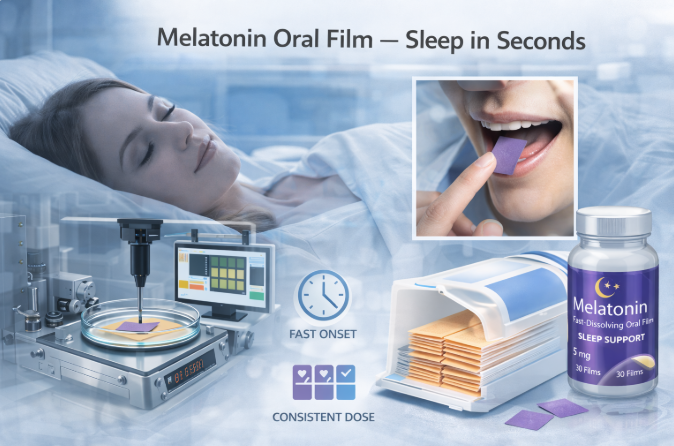
Methods
Melatonin Film Formulation
Melatonin oral films were formulated using rapidly hydrating, food-grade film-forming polymers selected for neutral mouthfeel and fast disintegration. Melatonin was uniformly dispersed at low-dose levels suitable for precise film-based dosing. Plasticizers and flavoring agents were optimized to balance mechanical integrity, taste masking, and rapid dissolution [3].
Manufacturing Process
Films were manufactured using solvent casting followed by controlled drying under defined temperature and humidity conditions. Film thickness and solid content were carefully controlled to ensure dose uniformity and predictable dissolution behavior. Films were cut into single-dose units suitable for individual packaging [4].
Stability and Packaging Considerations
Given melatonin’s sensitivity to light and moisture, packaging systems with appropriate barrier properties were selected. Stability studies were conducted to ensure preservation of melatonin content and film performance over shelf life [5].
Measures
Disintegration and Dissolution Time
Disintegration time was measured using simulated saliva at physiological temperature, recording the time required for the film to lose structural integrity [6].
Content Uniformity
Melatonin content uniformity was evaluated across multiple batches and film locations to confirm compliance with dosage consistency requirements [7].
Sensory and User Experience Evaluation
Taste, mouthfeel, and overall acceptability were assessed through structured sensory evaluations to reflect real-world consumer use [8].
Results
Melatonin oral films demonstrated rapid disintegration within seconds under simulated oral conditions. Content uniformity remained within tight specifications, confirming reliable low-dose delivery. Sensory evaluations indicated favorable taste and minimal residue, contributing to positive user experience. Stability testing showed that appropriate packaging effectively preserved melatonin potency and film integrity.
Discussion
The results confirm that melatonin oral films can successfully combine fast onset with consumer-centric design. Rapid dissolution enhances the perception of immediacy, while precise dosing and pleasant sensory properties support consistent use. Compared with tablets and capsules, oral films offer clear advantages for nighttime administration and on-demand use. These benefits position melatonin oral films as a differentiated and scalable sleep-support solution [9].
Conclusion
Melatonin oral films provide a fast, convenient, and consumer-preferred approach to sleep supplementation. Through optimized formulation, controlled manufacturing, and robust quality measures, these films can deliver melatonin reliably within seconds of administration. This technology supports the growing demand for innovative, fast-onset sleep aids and represents a promising direction for next-generation melatonin products.
References
Zisapel N. Melatonin and sleep. Open Neuroendocrinol J. 2010;3:85–95.
Ferracioli-Oda E, Qawasmi A, Bloch MH. Meta-analysis: Melatonin for the treatment of primary sleep disorders. PLoS One. 2013;8(5):e63773.
Preis M, Breitkreutz J. Oromucosal film formulations: From bench to bedside. Expert Opin Drug Deliv. 2017;14(6):1–12.
Hoffmann EM et al. Manufacturing of orodispersible films: From lab scale to production. Eur J Pharm Biopharm. 2011;78(3):447–455.
Cilurzo F et al. Stability and packaging of oral films. Eur J Pharm Biopharm. 2008;70(3):895–900.
Cilurzo F et al. Fast dissolving films: Technological properties. Eur J Pharm Biopharm. 2008;70(3):895–900.
European Pharmacopoeia. Uniformity of dosage units. EDQM, Strasbourg.
Stone H, Sidel JL. Sensory Evaluation Practices. Academic Press.
Morales JO, McConville JT. Consumer-oriented design of oral films. Eur J Pharm Biopharm. 2011;77(2):187–199.