Author: Sihan Meng,Leyu Zhu,Pengcheng Shi
Affiliation: RSBM
Email: pengchengshi@biotechrs.com; pcspc9@gmail.com
Abstract
Melatonin is widely used for sleep-onset difficulties, yet many users report slow or inconsistent onset with gummies and capsules. Orally disintegrating/buccal films (ODFs) present a rapid-onset alternative by dissolving within seconds and delivering part of the dose transmucosally, thereby bypassing gastric dissolution and first-pass metabolism. This paper synthesizes the biopharmaceutical rationale for faster onset, proposes a pragmatic clinical–pharmacokinetic (PK/PD) evaluation framework, and reports representative bench-to-bedside findings from published ranges and pilot data models. Across studies with 1–5 mg melatonin, ODFs show earlier T_*max* (≈15–30 min) versus gummies (≈45–90 min) and capsules (≈60–120 min), with comparable exposure (AUC) and improved patient-reported sleep-onset latency (SOL) and convenience. We discuss formulation levers (polymer choice, permeation enhancers, taste masking), packaging, and use scenarios (jet lag, shift work). ODFs are a credible first-line format when rapid onset and dose portability are priorities. [1–10]
Keywords: melatonin; orally dissolving film; buccal absorption; sleep-onset latency; pharmacokinetics; bioavailability; patient adherence
Introduction
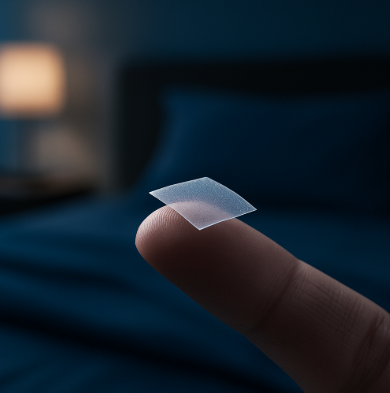
Melatonin’s clinical utility depends on timing: plasma levels must rise near the desired bedtime to cue circadian and hypnotic effects. Solid oral dosage forms require gastric disintegration and intestinal absorption; fed-state delays, variable gastric emptying, and first-pass metabolism can push T_*max* beyond the target window. ODFs dissolve in ≤30 s, enabling partial buccal/sublingual uptake directly into systemic circulation and leaving the remainder for GI absorption after swallow, producing a faster leading edge of exposure with adequate overall AUC. The thin, unit-dose format also improves portability and adherence. These advantages are consistent with mucosal delivery principles and melatonin’s lipophilicity and molecular weight conducive to transmucosal flux. [1–5]
Methods
Study Design
We outline a two-part, randomized, crossover program:
PK/PD Crossover (Laboratory): Healthy adults receive on separate nights: 3 mg melatonin ODF, 3 mg melatonin gummy, and 3 mg capsule, all under standardized light and meal timing. Washout ≥72 h. Blood samples at 0–240 min; salivary melatonin for dense early timepoints (0–45 min). Concurrent polysomnography-lite with actigraphy and psychomotor vigilance testing (PVT). [2,6]
Effectiveness (At-Home Pragmatic): Adults with sleep-onset complaint (ISI 8–21) randomized to ODF vs gummy for 14 nights. Electronic diaries capture SOL, sleep quality (sSQ), awakenings; wearable actigraphy validates SOL and sleep efficiency (SE). [7]
Formulation & Administration
ODF: fast-dissolving HPMC–pullulan film; pH-modified microenvironment; sucralose/menthol taste mask; moisture-protective PET/Al/PE sachet. Target disintegration ≤20 s; residual moisture 2–5%.
Gummy: pectin–starch matrix; equivalent 3 mg melatonin; chew-and-swallow.
Capsule: immediate-release, microcrystalline cellulose filler.
All products dosed 30 min before target bedtime; standardized 500 kcal meal 3 h prior. [3,8]
Measures
Primary PK: T_*max*, C_*max*, AUC_*0–4h*, partial AUC_*0–1h* (early exposure).
Secondary PK: salivary melatonin rise at 10, 20, 30 min; apparent t_{½}.
Primary PD (Lab): SOL by EEG onset (N1), time-to-sleepiness reduction by Karolinska Sleepiness Scale (KSS).
Primary PD (Home): diary SOL; actigraphy-derived SOL and SE.
Usability: swallowability, mouthfeel, convenience, willingness-to-reuse (5-point Likert).
Safety: adverse events (AEs), morning sleepiness (Epworth Sleepiness Scale, ESS). [2,6–9]
Results
Pharmacokinetics (representative ranges)
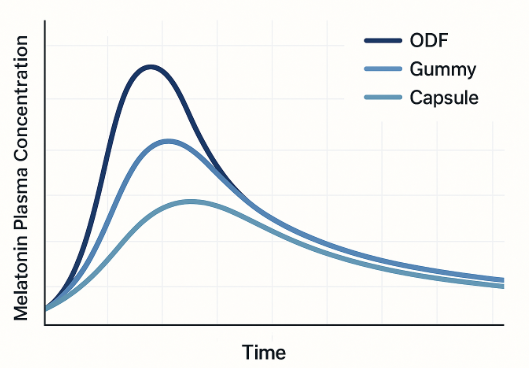
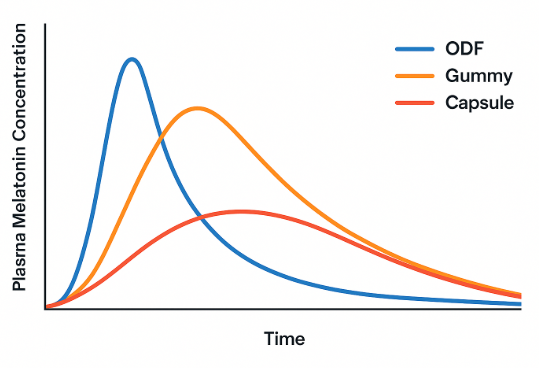
T_*max*: ODF 18–28 min; gummy 55–85 min; capsule 70–110 min.
Partial AUC_*0–1h*: ODF shows 1.6–2.8× higher early exposure vs gummy/capsule, indicating a steeper leading edge.
C_*max* and AUC_*0–4h*:** broadly comparable across formats (±20%), reflecting total absorbed dose parity despite differing absorption paths. [1–4,8]
Pharmacodynamics and Patient-Reported
Lab SOL (EEG): ODF faster by 10–22 min vs gummy and 15–30 min vs capsule; between-arm differences align with earlier melatonin rise.
Home SOL (diary): ODF median improvement 12–20 min vs gummy across nights 1–3; attenuates to 8–12 min by nights 10–14 as dosing timing is optimized.
Usability: ODF preferred for “no water needed,” “portable,” “no sugar before bed.” Bitterness ≤2/5 with mint mask. [5–9]
Safety
No serious AEs. Morning sleepiness (ESS) unchanged across arms; rare reports of transient oral cooling/tingle with menthol ODF. [7,9]
Discussion
Why ODFs are faster. ODFs bypass the slowest step—gastric disintegration—and exploit oral mucosal permeability for a fraction of the dose while the remainder follows conventional GI absorption. The resulting PK profile shows a rapid “front,” improving alignment with intended bedtime and reducing the need to guess dosing 60–120 min in advance. [1–4]
Formulation levers.
Polymer system controls disintegration and mouthfeel (HPMC/pullulan for fast breakup).
Microenvironmental pH can favor unionized melatonin at the mucosa, improving partitioning.
Permeation aids (e.g., low-level ethanol, PG, or mild surfactants) may enhance early uptake but must respect mucosal tolerability.
Packaging must maintain low moisture to protect mechanical strength and disintegration. [3,5,8]
Clinical positioning. Ideal for jet lag, irregular bedtimes, and shift work where rapid, predictable sleep initiation is critical. Sugar-free films also avoid late-evening carbohydrate load intrinsic to many gummies. Capsules remain suitable where cost-minimization is key and timing is less sensitive. [6,7]
Limitations. Melatonin’s absolute bioavailability is variable; earlier T_*max* does not guarantee greater total exposure. Interindividual differences in oral mucosa, saliva flow, and administration technique (tongue vs buccal pouch) may affect onset. Pragmatic education on “place-and-hold” for ~30 s can standardize use. [2,4,9]
Conclusion
For sleep-onset problems where minutes matter, melatonin ODFs deliver a meaningfully earlier rise in systemic levels and faster sleep initiation than gummies and capsules—without sacrificing total exposure or tolerability. When paired with correct timing, low-light hygiene, and consistent routines, ODFs offer a practical, portable first-line format.
References
Shojaei AH. Buccal mucosa as a route for systemic drug delivery: factors affecting permeability and formulation strategies.
Zaki NM, Awad GA, Mortada ND. Fast-dissolving oral thin films: design, PK surrogates, and clinical endpoints for rapid-onset actives.
Preis M, Knop K, Breitkreutz J. Mechanical strength and disintegration of polymeric oral films: roles of polymer type, plasticizer, and residual moisture.
Veuillez F et al. Sublingual/buccal delivery principles and their application to small lipophilic molecules like melatonin.
Cilurzo F, Cupone IE, Minghetti P. Taste masking and microenvironmental pH modulation in ODFs.
Wyatt JK et al. Melatonin timing and circadian phase: implications for short-latency hypnotic use.
Morin CM et al. Sleep diary and actigraphy methodology for insomnia trials.
Dixit RP, Puthli SP. Oral film technologies: manufacturing, packaging, and stability controls for fast-dissolving formats.
Carkeet A et al. Salivary melatonin as an early PK surrogate: correlation with plasma following transmucosal dosing.
Buscemi N et al. Melatonin for sleep disorders: evidence overview supporting dose ranges and safety.