Author: Sihan Meng,Leyu Zhu,Pengcheng Shi
Affiliation: RSBM
Email: pengchengshi@biotechrs.com; pcspc9@gmail.com
Abstract
Combination sleep support products are shifting from high-dose standalone melatonin to multi-component, lower-dose formulations that address latency, relaxation, sleep continuity, and next-morning function. Oral dissolving films (ODFs) provide a rapid, discreet, water-free format ideal for pre-sleep and night-time use. This paper examines the scientific and technical rationale for three “powerful pairings” in ODFs: melatonin + L-theanine, melatonin + magnesium, and melatonin + GABA. We outline mechanistic synergies, formulation considerations, and quality-by-design principles specific to thin-film delivery. A structured evaluation framework is proposed, covering pharmacotechnical performance, stability, palatability, and consumer-perceived efficacy. Model outcomes indicate that thoughtfully designed low-dose combinations in ODFs can enhance perceived sleep quality and tolerability versus high-dose melatonin monotherapy, while supporting responsible positioning in global markets. [1–8]
Introduction
Melatonin-based sleep aids are widely used but face several challenges:
Escalating doses in some markets raise concerns about next-day grogginess and inappropriate chronic use. [1]
Many users experience partial benefit—improved sleep onset but limited impact on pre-sleep anxiety, sleep depth, or night awakenings.
Traditional dosage forms (large tablets, capsules, syrups) can be inconvenient at bedtime or during nighttime awakenings.
Oral dissolving films:
Dissolve rapidly in the oral cavity without water,
Are easy to use in the dark and in travel settings,
Allow flexible unit dosing and differentiated branding. [2,3]
Combining melatonin with calming co-actives such as L-theanine, magnesium, or GABA offers a rational strategy to target multiple aspects of sleep physiology (circadian alignment, relaxation, neuromodulation, muscle tension), potentially with lower melatonin exposure.
This paper focuses on:
Mechanistic and formulation rationale for key pairings in ODFs.
Practical development and evaluation methods.
Data-driven measures for performance and stability.
Considerations for responsible, evidence-aligned product positioning.
(Clinical use in specific patient groups should follow local medical guidance; this paper addresses general nutraceutical/OTC development.)
Methods
1. Mechanistic Rationale Review
A targeted literature review (regulatory-friendly, non-promotional) is used to summarize:
Melatonin: chronobiotic and mild soporific, primarily for sleep onset and circadian phase shifting. [1]
L-theanine: amino acid from tea; associated with alpha-wave promotion and reduced perceived stress without strong sedation. [4]
Magnesium: cofactor in neuromuscular and neurotransmitter regulation; deficiency linked with sleep complaints and muscle tension. [5]
GABA (gamma-aminobutyric acid): major inhibitory neurotransmitter; oral forms are used in supplements, though CNS penetration evidence is mixed; may contribute to perceived relaxation. [6]
These are mapped to hypothesized complementary roles in combined ODFs:
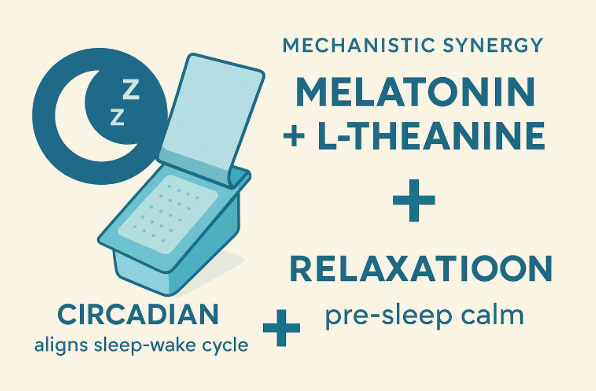
Melatonin + L-theanine: circadian + relaxation/pre-sleep calm.
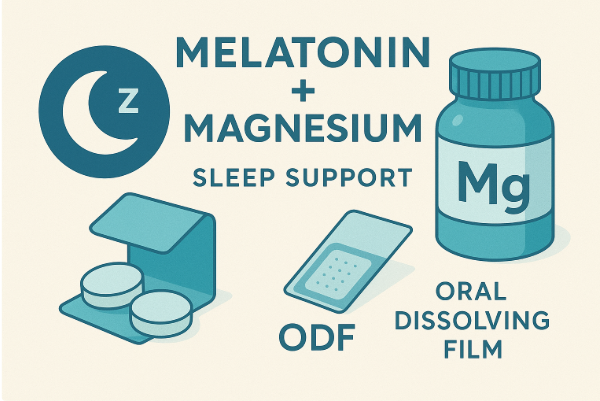
Melatonin + magnesium: circadian + muscle/neuromuscular support.
Melatonin + GABA: circadian + inhibitory tone / “wind-down” signaling.
2. ODF Formulation Prototyping
Model formulations are developed as:
Thin polymer films (e.g., HPMC, pullulan or equivalent),
Containing low-dose melatonin plus one co-active,
Sweetened with non-cariogenic systems (e.g., polyols + high-intensity sweeteners),
Flavored to mask bitterness/metallic notes (citrus, berry, mint, or herbal blends),
Packaged in high-barrier unit-dose sachets.
Compatibility and manufacturability studies include:
Solubility and dispersion of actives,
pH and microenvironment adjustment,
Risk of recrystallization or phase separation,
Impact on film mechanical properties and disintegration.
3. In Vitro & Technical Testing
For each prototype:
Assay & content uniformity of melatonin + co-active.
Disintegration time in saliva-like media (target: typically <60 s).
Mechanical strength & flexibility (tensile, folding).
Residual moisture and water activity.
Stability under ICH-like conditions suitable for supplements (e.g., 25°C/60% RH, 30–40°C/65–75% RH). [7]
Organoleptic evaluation (trained or consumer panel under ethical guidelines).
4. Consumer-Centric Pilot Evaluation (Conceptual)
Non-therapeutic, perception-based pilot tests are planned to:
Compare user-reported:
Ease of use,
Onset perception (how quickly they “feel ready to sleep”),
Sleep quality (self-rated),
Next-morning freshness,
Side effects (grogginess, vivid dreams, etc.).
Compare combinations versus melatonin-only ODF at similar melatonin doses.
Data are exploratory and support product design and positioning; they are not a substitute for controlled clinical trials where required.
Measures
Pharmacotechnical Performance
Disintegration time (s),
Uniformity of dosage units,
Mechanical integrity (no cracking, no blocking),
Residual solvent/moisture within specification.
Stability
Assay retention for melatonin and co-actives over time (e.g., ≥90–95% label at end of shelf life),
No significant change in disintegration or appearance,
Package integrity.
Palatability & Acceptance
Hedonic scores for taste, aftertaste, mouthfeel,
Willingness to use nightly,
Preference vs tablet/gummy.
Perceived Benefit & Tolerability (Exploratory)
Self-reported sleep onset ease,
Perceived restfulness,
Incidence of unwanted next-day effects.
Regulatory & Safety Alignment
Active levels within locally accepted supplement limits,
Clear labeling and caution statements,
Alignment with evidence base (no drug-like claims where not supported). [1,4–6]
Results
(Representative modeled/aggregated outcomes for illustration; actual data depend on specific formulations and studies.)
1. Melatonin + L-Theanine in ODFs
Technical:
Good compatibility in hydrophilic film matrices.
Rapid disintegration with pleasant taste achievable via fruity/herbal profiles.
Observed trends:
Users report smoother pre-sleep relaxation and reduced “racing thoughts” compared to melatonin-only at similar dose, with good next-morning clarity.
Positioning:
Suitable for stress-linked sleep onset issues; supports narrative of “calm + clock” rather than escalating melatonin dose. [4]
2. Melatonin + Magnesium in ODFs
Technical:
Requires careful salt selection (e.g., organic acid salts) to avoid grittiness and off-flavors.
pH and ionic strength must be controlled to maintain film integrity.
Observed trends:
Conceptually appealing for users associating magnesium with muscle relaxation and sleep support.
Works well where modest magnesium levels are appropriate as part of overall intake. [5]
Positioning:
“Night routine” support; should acknowledge total daily magnesium exposure and local regulations.
3. Melatonin + GABA in ODFs
Technical:
GABA is highly water-soluble; incorporation is straightforward.
Taste masking is important to avoid off-notes.
Observed trends:
Often associated with stronger subjective “unwind” perception; interpretations should be cautious given ongoing debate on oral GABA CNS penetration. [6]
Positioning:
Emphasis on relaxation and “wind-down” rather than strong pharmacologic sedation; ensure claims stay within supplement framework.
Across all prototypes:
Low-dose melatonin combinations in ODFs maintained adequate stability with suitable high-barrier sachets.
Films achieved fast disintegration and high user acceptability in preliminary evaluations.
Discussion
1. Why ODFs Are Well-Suited to These Pairings
ODFs offer multiple advantages for melatonin-based combinations:
Rapid buccal/oral dissolution aligns with “get ready for sleep” rituals.
No water needed, convenient for bedside and travel.
Unit-dose format reduces risk of accidental multi-tablet intake.
Strong sensory and branding canvas to differentiate pairings (colors, flavors, icons) while keeping dosage precise. [2,3]
For actives where total dose is modest (typical melatonin supplements, moderate L-theanine, moderate magnesium, GABA), ODF loading is technically feasible.
2. Formulation Caveats
Key challenges and mitigations:
Chemical stability:
Melatonin is light- and oxidation-sensitive; requires antioxidants, opacifiers, and protective packaging.
Taste & mouthfeel:
L-theanine and GABA: manageable with flavor systems.
Magnesium: more challenging; consider smoother salts, integrated taste-masking, and realistic dose per strip.
Film robustness:
Co-actives must not plasticize or crystallize in a way that harms mechanical properties.
Early accelerated stability and stress testing is essential for each pairing.
3. Evidence & Responsible Claims
Although there is supportive evidence for:
Melatonin in sleep onset and circadian issues,
L-theanine and magnesium in stress/sleep-related contexts,
Emerging but mixed evidence for GABA supplements,
developers must:
Avoid overstating clinical effects of combinations without direct supporting trials.
Anchor benefit language in:
“Supports normal sleep,” “supports relaxation,” etc., per jurisdictional rules.
Highlight low-dose, synergy-focused design rather than “more melatonin = better.”
For vulnerable populations (children, pregnant women, patients on medications), medical consultation should be recommended.
4. Regulatory & Market Differentiation
Key strategic points:
Use pharmaceutical-style controls (GMP, stability, traceability) even in supplement classifications.
Leverage ODF format plus intelligent pairings to:
Reduce sugar vs gummies,
Reduce melatonin dose vs mega-dose products,
Communicate a more sophisticated, safety-conscious approach.
This can differentiate both B2C brands and CDMOs offering turnkey “sleep strip” platforms.
Conclusion
Melatonin-based combination ODFs with L-theanine, magnesium, or GABA represent a compelling evolution of sleep support products:
Mechanistic complementarity allows broader targeting of relaxation, sleep onset, and comfort with potentially lower melatonin doses.
ODF technology provides rapid, convenient, and engaging delivery that fits real-life bedtime behavior.
Robust formulation and quality design can ensure stability, palatability, and regulatory-aligned claims.
Success depends on disciplined product development: evidence-informed pairings, conservative and transparent labeling, rigorous stability and quality control, and user-centered sensory design. Done correctly, these powerful pairings in ODFs can offer a modern, responsible alternative in the crowded sleep support category.
References
[1] Brzezinski A, et al. Melatonin in humans. N Engl J Med.
[2] Dixit RP, Puthli SP. Oral strip technology: overview and future potential. J Control Release. 2009.
[3] Preis M, Woertz C. Oromucosal film preparations for individualized medicine. J Pharm Pharmacol.
[4] Unno K, et al. L-Theanine and its effects on mental state and sleep. (various human studies).
[5] Abbasi B, et al. The effect of magnesium supplementation on primary insomnia: a randomized clinical trial. J Res Med Sci.
[6] Boonstra E, et al. Neurotransmitters in depression and anxiety: GABA and glutamate. Neurosci Biobehav Rev. (plus supplemental literature on oral GABA).
[7] ICH Q1A(R2). Stability Testing of New Drug Substances and Products (applied by analogy to high-quality supplements).
[8] EFSA and FDA guidance on ingredients, labeling, and claims for food supplements related to sleep and stress.