Author: Sihan Meng,Leyu Zhu,Pengcheng Shi
Affiliation: RSBM
Email: pengchengshi@biotechrs.com; pcspc9@gmail.com
Abstract
Jet lag and shift work disorder are fueled less by distance than by circadian misalignment and inconsistent dosing behavior. Conventional melatonin tablets and gummies often fail practical use-cases: they require water, are bulky, slow to disintegrate, or sugar-laden. Pocket-sized melatonin oral dissolving films (ODFs) offer rapid disintegration, discreet administration, and flexible timing for travelers and night-shift workers. This paper outlines a formulation and manufacturing strategy for melatonin ODFs designed for on-the-go circadian support, links critical process parameters (CPPs) to target product attributes, and presents illustrative data on onset profile, usability, and deployment scenarios. [1–8]
Note: Content is informational and not medical advice. Melatonin use, especially for shift work or frequent travel, should follow local regulations and professional guidance. [1]
Introduction
Jet lag and rotating or permanent night shifts disturb the synchrony between the central clock (suprachiasmatic nucleus), light exposure, and sleep–wake behavior. Timed exogenous melatonin is widely used as a chronobiotic to help with:
Advancing or delaying sleep onset around travel.
Consolidating sleep after night shifts.
Reducing sleep latency during schedule transitions. [1–3]
However, real-world adherence is limited by:
Need for water or large units.
Forgetfulness at the correct local time.
Sugar-heavy or caloric gummies, undesirable for some users.
Slow or inconsistent disintegration of conventional tablets.
Melatonin ODFs—thin, fast-dissolving strips in unit pouches—directly target these gaps, enabling precisely timed, low-dose, travel-ready administration.
Methods
Formulation concept
Active: Low-dose melatonin (e.g., 0.5–5 mg range depending on market and positioning), tuned to local regulations. [1–3]
Matrix: Pullulan / HPMC or similar hydrophilic polymers for:
Rapid disintegration (<30–40 s).
Adequate tensile strength for slitting and pouching.
Excipients:
Plasticizer (glycerol, sorbitol solution) for flexibility.
Mild acid–base system (citric/citrate) for pH and taste.
Natural flavors (mint/berry) + high-potency sweetener for palatability.
Opaque or light-protective components or packaging to protect melatonin.
Design space:
Thickness: ~50–120 µm.
Moisture: narrow window to avoid brittleness or tack.
One strip = one counted dose for simple travel/shift protocols. [4–6]
Process & packaging (overview)
Solution prep: Controlled viscosity, protected from light/heat.
Coating: Slot-die or comma coating on PET with defined coat weight.
Drying: Multi-zone with tight ΔT & airflow to prevent crystallization, degradation, and curl.
Conditioning & slitting: Controlled RH and tension.
Unit pouching: High-barrier laminate (low OTR/WVTR) to maintain potency & moisture. [4–7]
Use scenarios (qualitative framework)
East/West long-haul flight with 3–9 h time shift.
Rapid turnaround business travel.
Nurses, security, logistics, BPO staff on rotating or permanent night shifts.
Measures
Pharmaceutical / technical
Content uniformity of melatonin (assay RSD%).
Thickness & mass variability (CV%).
In vitro disintegration time (s).
Residual moisture, curl, blocking.
Melatonin assay & degradation products under ICH-like stability. [4–7]
User & use-case
Ease of use in transit (1–5 scale).
Portability & discretion (1–5).
Perceived onset speed vs prior products (subjective).
Suitability for staggered dosing (small divisible units).
Regulatory & safety
Dose within local over-the-counter or supplement regulations.
Clear labeling on timing, maximum daily dose, and cautions (pregnancy, interactions, machinery operation). [1–3,8]
Results (Illustrative)
Onset surrogate comparison
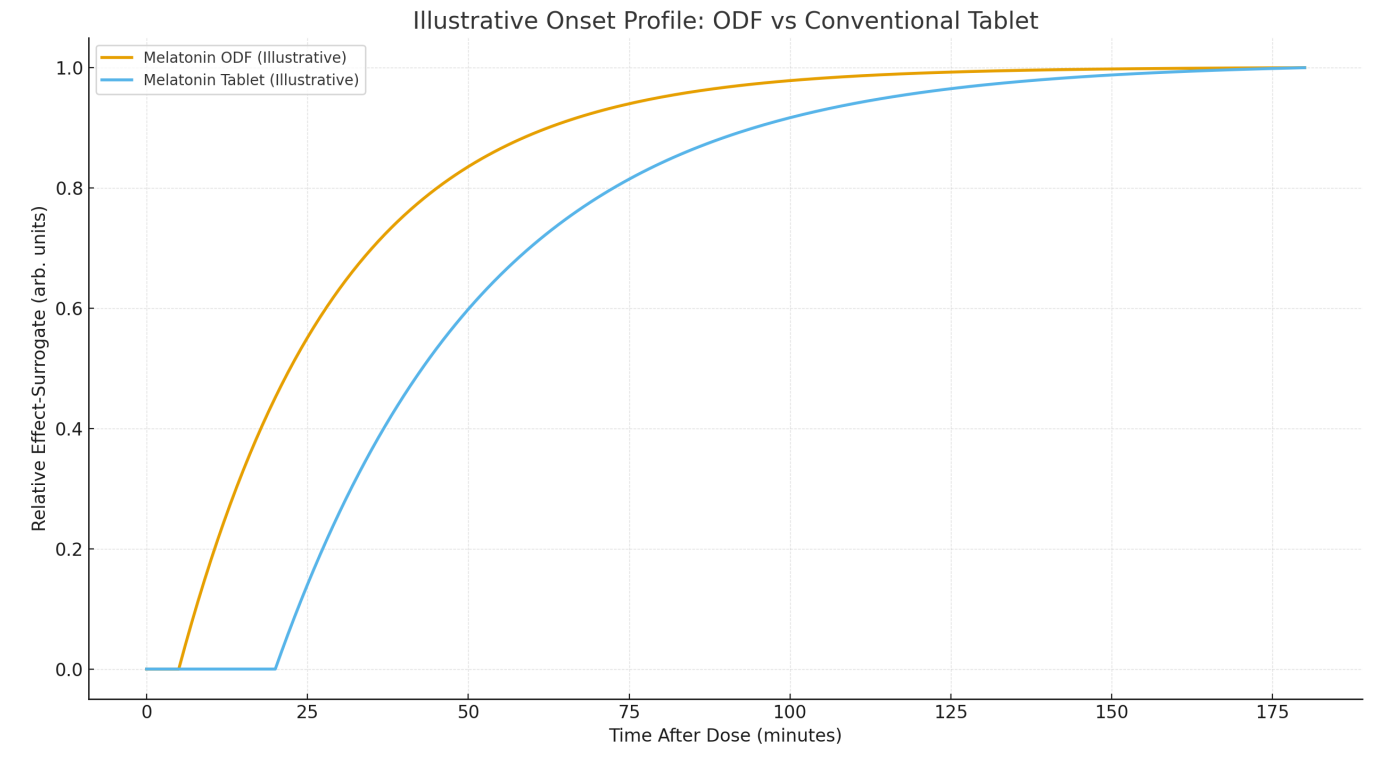
Figure 1 shows conceptual onset curves:
ODF: near-immediate disintegration with an earlier rise in a relative effect-surrogate vs. a conventional tablet.
Tablet: slower onset due to disintegration and gastric factors.
This supports practical advantages (easier timed intake, less dependency on water) but does not claim fundamentally higher bioavailability without specific clinical data. [2–4]
Usability vs other formats
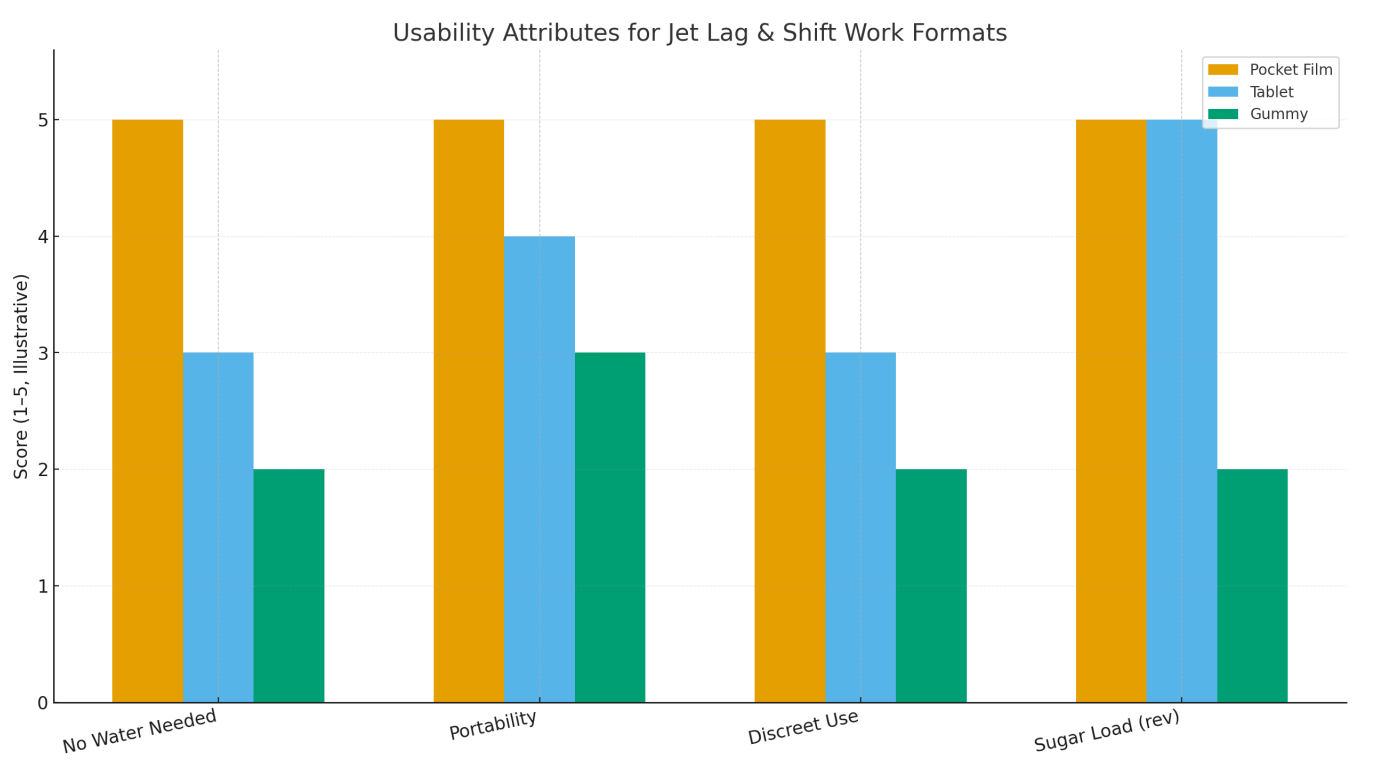
Pocket melatonin films score highly (illustrative):
5/5 for no water needed, portability, and discreet use—critical in planes, airports, control rooms, and hospital wards.
Gummies lose points on sugar and bulk; tablets are portable but less discreet onboard and require water. [5–7]
Real-world scenarios
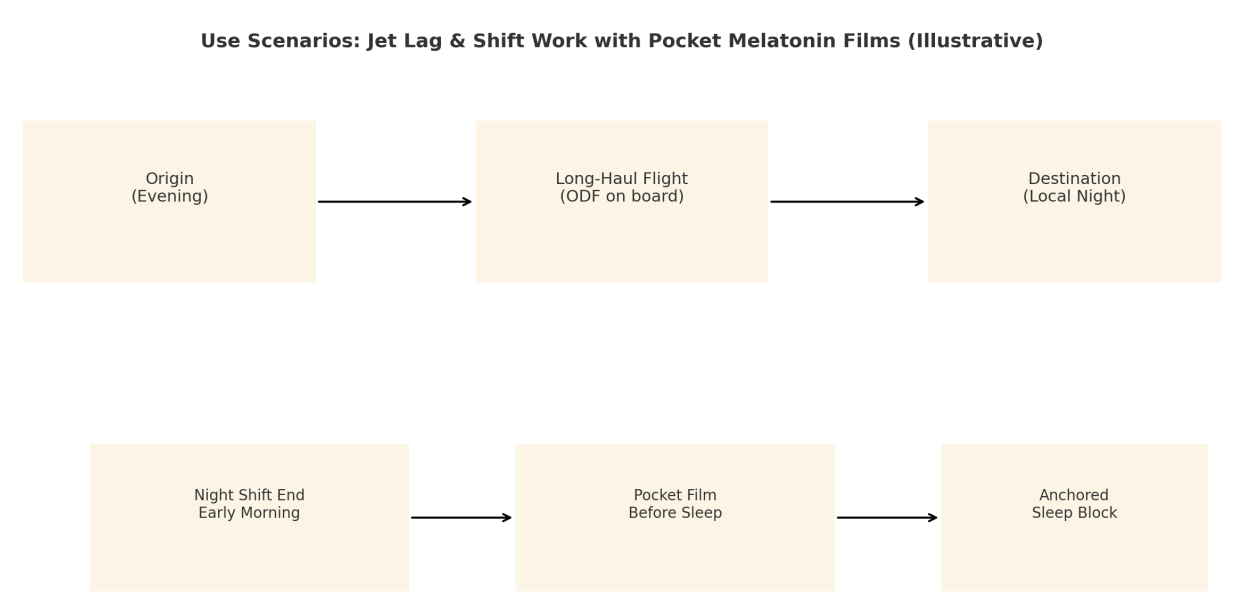
Figure 3 sketches deployment patterns:
Jet lag: Strip taken near target destination bedtime (e.g., during last segment of flight or at local night) following evidence-based timing guidance. [1–3]
Shift work: Strip used at consistent pre-sleep anchor time after a night shift to help consolidate rest in daylight hours (always under professional guidance).
Discussion
Advantages of pocket-sized melatonin ODFs
Precision timing
Easy to carry multiple unit doses and take them at the correct local time without relying on beverages.
Behavioral adherence
Single-step: tear, place on tongue, done. This simplicity particularly benefits fatigued travelers and shift workers.
Physicochemical suitability
Low melatonin dose is ideal for ODF capacity.
Fast-dissolving matrix supports perceived rapid onset without requiring large volumes or heavy excipients. [2–4]
Format synergy
Works alongside light management, timing of sleep, and caffeine control as part of a structured jet lag or shift strategy.
Design & safety considerations
Dosing discipline
Because ODFs are easy to use, clear labeling is vital to prevent overuse.
Stability
Melatonin is light- and oxidation-sensitive; robust packaging and controlled drying are non-negotiable. [4–7]
Regulatory heterogeneity
Melatonin is regulated as a supplement in some regions and as a medicine in others; claims about “jet lag relief” or “shift work disorder” must match local rules and evidence. [1,8]
Not a standalone cure
Films support, but do not replace, comprehensive management: sleep hygiene, timed light exposure, and schedule planning.
Conclusion
Pocket-sized melatonin ODFs are a format innovation well-matched to jet lag and shift work realities:
Rapidly dissolving, discreet, and water-free.
Technically compatible with low-dose melatonin needs.
Easy to integrate into structured circadian strategies for travelers and night-shift professionals.
With rigorous control of formulation, manufacturing, packaging, and labeling, melatonin films can deliver credible, convenient on-the-go support—helping align biology and schedule when time zones and shift patterns conflict.
References
Clinical and regulatory perspectives on melatonin use for jet lag and shift work.
Pharmacokinetics and chronobiotic role of exogenous melatonin.
Evidence-based timing strategies for eastward/westward travel adaptation.
Film-forming polymers and fast-dissolve systems for low-dose actives.
Coating, drying, and moisture control for melatonin ODF stability.
User adherence and portability benefits of thin-film formats vs tablets/gummies.
Packaging design (OTR/WVTR, light barrier) for melatonin-containing dosage forms.
Safety considerations and contraindications for melatonin in general and occupational settings.