Author: Sihan Meng,Leyu Zhu,Pengcheng Shi
Affiliation: RSBM
Email: pengchengshi@biotechrs.com; pcspc9@gmail.com
Abstract
Clean-label sleep strips (oral dissolving films; ODFs) promise simple ingredient decks, rapid bedtime dosing, and portable packs. This paper links formulation and process choices to consumer-visible claims—sugar-free, vegan, non-GMO, allergen-free—and to performance outputs: disintegration time, residual moisture, flavor/aftertaste, and pack opening force. Three figures show (i) an ingredient-to-claim compliance matrix, (ii) KM-like disintegration profiles at two room humidities, and (iii) format preference among clean-label shoppers. We provide a practical checklist for claim substantiation and GMP-aligned in-process control (IPC). [1–9]
Introduction
“Clean label” in sleep aids typically means short, recognizable ingredients, no added sugars, vegan excipients, non-GMO sourcing, and no artificial colors. ODFs fit these expectations while enabling fast disintegration without water and precise micro-dosing of agents such as melatonin, L-theanine, and botanical adjuncts (e.g., chamomile). Yet clean-label constraints can influence rheology, coating, and taste-masking, so a CPP→CQA approach is essential. [2–6]
Methods
Formulation (clean deck).
Matrix: HPMC/Pullulan; plasticizer: vegetable glycerol; buffers: citric/citrate; sweeteners: stevia/monk fruit; natural flavors (berry/mint); actives: melatonin (USP) with optional L-theanine/chamomile extract. Avoid gelatin, sugar syrups, artificial colors; audit suppliers for non-GMO affidavits. [2–5,9]
Process.
Slot-die coating at tuned solids% to hit dose via coat weight; multi-zone drying set for exit moisture 1.6–2.4%; conditioning at 22–24 °C, 45–55% RH; slitting; sachet FFS with validated seal window. [3–7]
Controls & substantiation.
Supplier documentation (vegan, non-GMO, allergen), COAs, change-control; label claim matrix mapping each component to each claim.
IPC: inline thickness/moisture (PAT), disintegration testing, sensory panels for aftertaste. [4–8]
Measures
Clean-label: claim matrix completion (%), supplier affidavit coverage (%), colorant screen (HPLC or negative list).
Performance: disintegration time (s), residual moisture (%), thickness CV%, assay RSD%, seal/opening force (N), pouch reject ppm.
Sensory/UX: taste, aftertaste, mouthfeel, ease-of-use, perceived onset (Likert).
Compliance: vegan/non-GMO/allergen-free verification per lot; traceability to suppliers. [1–9]
Results
Ingredient–claim alignment
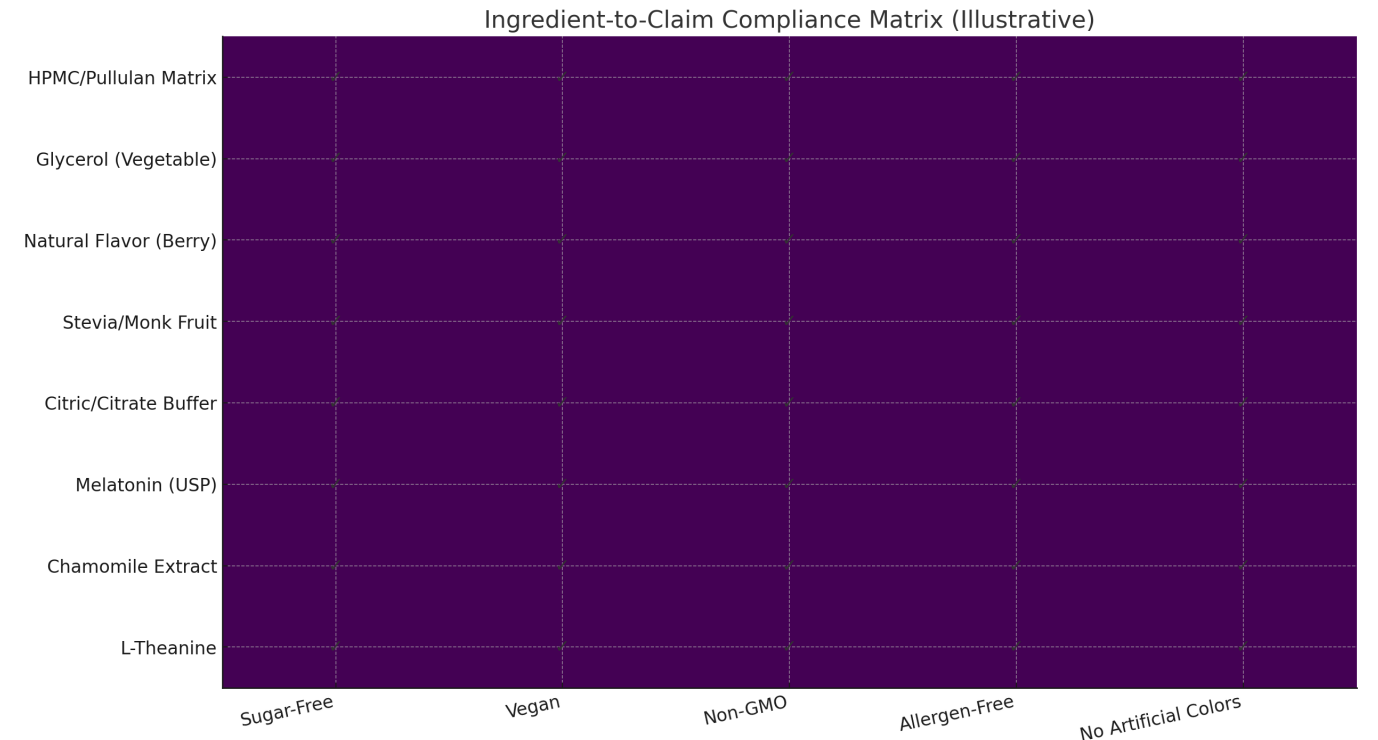
Figure 1 shows an illustrative compliance matrix: a standard clean deck can fully satisfy sugar-free, vegan, non-GMO, allergen-free, no artificial colors, provided sourcing documents and colorant policies are enforced. [1–2,9]
Disintegration under real room conditions
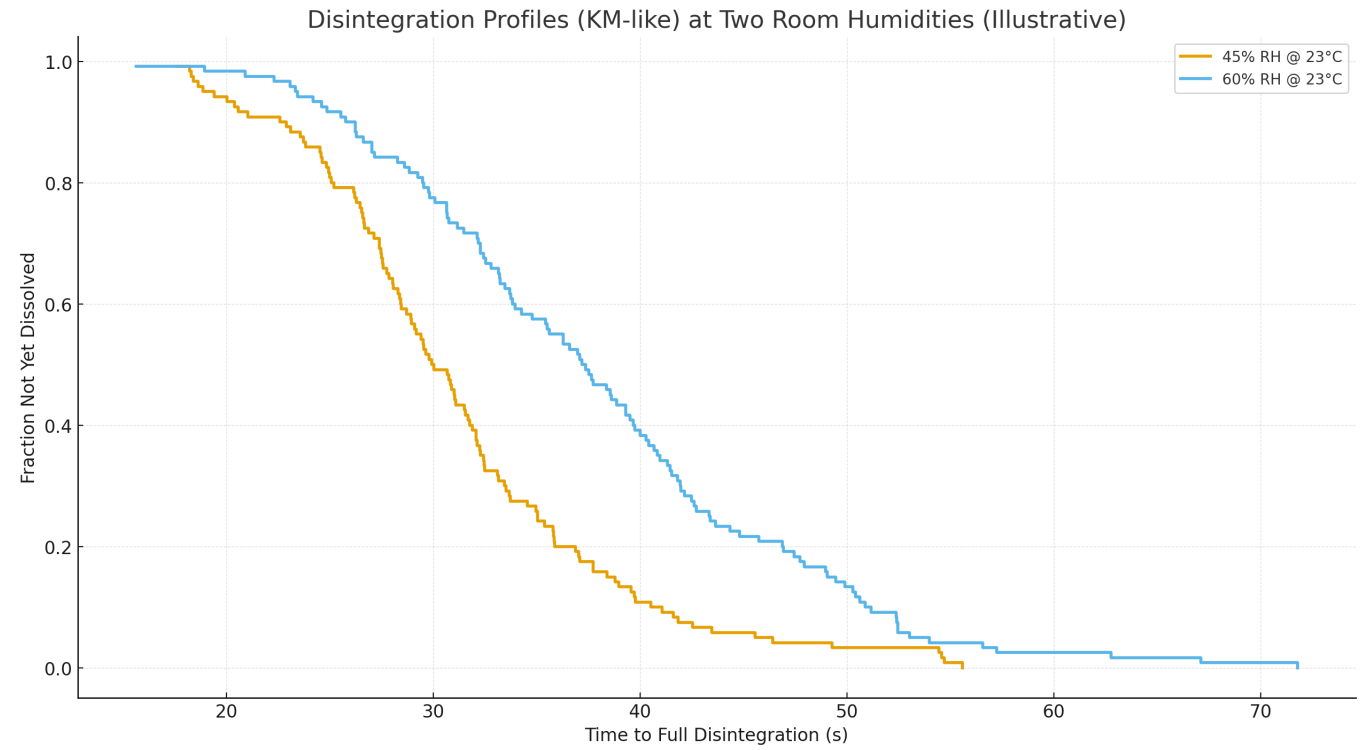
Figure 2 compares KM-like disintegration curves at 45% vs 60% RH. Higher humidity slightly extends tail times, but median times remain within a 15–40 s envelope when exit moisture is controlled. This underscores the need for consistent drying/conditioning and moisture-tight laminate. [3–7]
What clean-label shoppers prefer
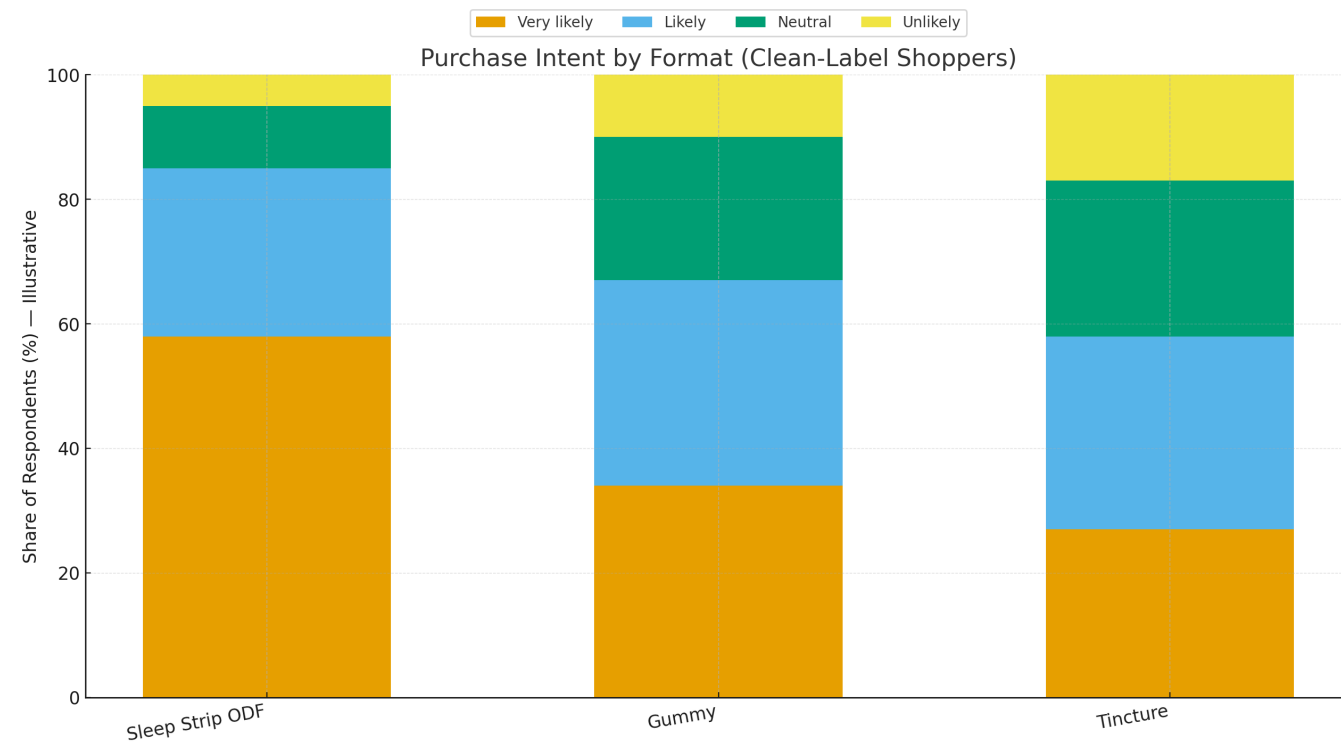
Figure 3 (stacked bars) indicates higher purchase intent for sleep strips versus gummies or tinctures among clean-label-oriented respondents—driven by sugar avoidance, portability, and no-mess dosing. [6–8]
Discussion
Formulation rules that keep labels clean—and films great
Polymer matrix: HPMC/Pullulan supports fast disintegration and vegan claims; avoid gelatin and maltodextrin syrups when “sugar-free” is required. [2–5]
Taste-masking without sugars: pair citric/citrate with natural flavors and high-potency sweeteners; avoid polyols that can add calories or GI effects at larger loads.
Moisture governance: validate a 1.6–2.4% window; align exit moisture with pack seal window to stabilize aftertaste and opening force. [3–7]
Color policy: eliminate artificial lakes/dyes; natural hues only if used at all; many brands prefer no added color for sleep SKUs. [1–2]
Verification that stands up in audits
Maintain a claim matrix per SKU with supplier affidavits, non-GMO statements, and vegan/allergen letters; lock in change-control so substitutions auto-trigger QA review.
Use PAT (NIR moisture, thickness) and EWMA/SPC to hold process in control; keep historian data ALCOA+ compliant. [4–8]
Limitations
Extremely high botanical loads may challenge taste and film integrity without bulking sugars; consider dose-splitting or micro-encapsulation within clean-label boundaries.
Regulatory landscapes vary (e.g., melatonin status by country); labeling must follow local dietary supplement rules. [9]
Conclusion
Clean-label sleep strips can be sugar-free, vegan, non-GMO, allergen-free—and still deliver great taste and fast melt—when ingredient sourcing, moisture control, and taste-masking are co-engineered. With disciplined claim substantiation and GMP-aligned IPC, brands can meet consumer expectations while sustaining robust yields and stable packs.
References
Clean-label definitions and consumer drivers in nutraceutical formats.
Vegan/non-GMO excipient selection for oral films (HPMC, pullulan, vegetable glycerol).
ODF coating science: solids%, coat weight, leveling vs drying time; residual moisture windows.
QbD/PAT for thin films: inline thickness/moisture, historian/ALCOA+, and SPC/EWMA.
Taste-masking without sugars: acid–sweetener systems and natural flavors.
Adherence and purchase intent drivers: portability, no-water dosing, sugar avoidance.
Packaging integration: laminate OTR/WVTR, seal/opening-force windows; moisture robustness.
Sensory/UX testing for aftertaste and perceived onset in film formats.
Supplier documentation, change-control, and label-claim substantiation for vegan/non-GMO/allergen-free claims.