Author: Sihan Meng,Leyu Zhu,Pengcheng Shi
Affiliation: RSBM
Email: pengchengshi@biotechrs.com; pcspc9@gmail.com
Abstract
Uniform, pouch-ready oral dissolving films (ODFs) start with slot-die engineering that delivers flat cross-web thickness at commercial line speeds. We present a pragmatic toolkit—edge-bead removal (EBR), lip-shim tuning, manifold distribution control, and process-window mapping (flow vs speed)—and link these controls to critical quality attributes (CQAs): thickness CV%, content uniformity, curl, and blocking. Three figures illustrate (i) cross-web thickness profiles with/without EBR and shims, (ii) a process window contrasting starvation and ribbing, and (iii) manifold design effects (T-slot vs coat-hanger) on coat-weight uniformity. [1–9]
Introduction
In ODF coating, edge bead and lateral maldistribution translate directly into dose non-uniformity, curl, and downstream pouch rejects. While formulation/rheology matter, hardware geometry—die lips, restrictors, manifold, and EBR—largely determines whether a good recipe can run at rate without defects. This paper details slot-die levers and shows how to center a stable flow-speed window that scales from pilot to 24/7 production. [2–6]
Methods
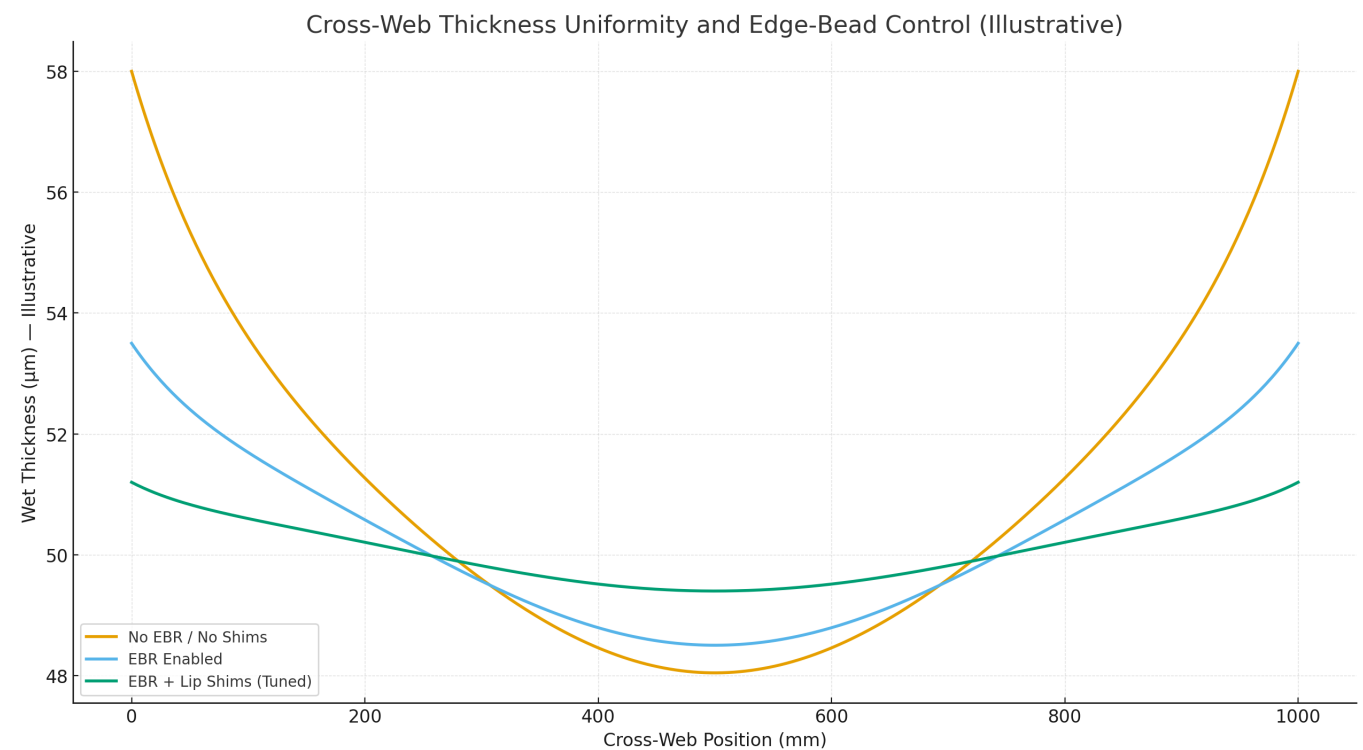
Cross-web uniformity program. Measure inline thickness (laser triangulation/IR) across the web; compute CV% and P–V. Iteratively deploy EBR and lip shims to flatten edges and correct mid-span bias. [3–6]
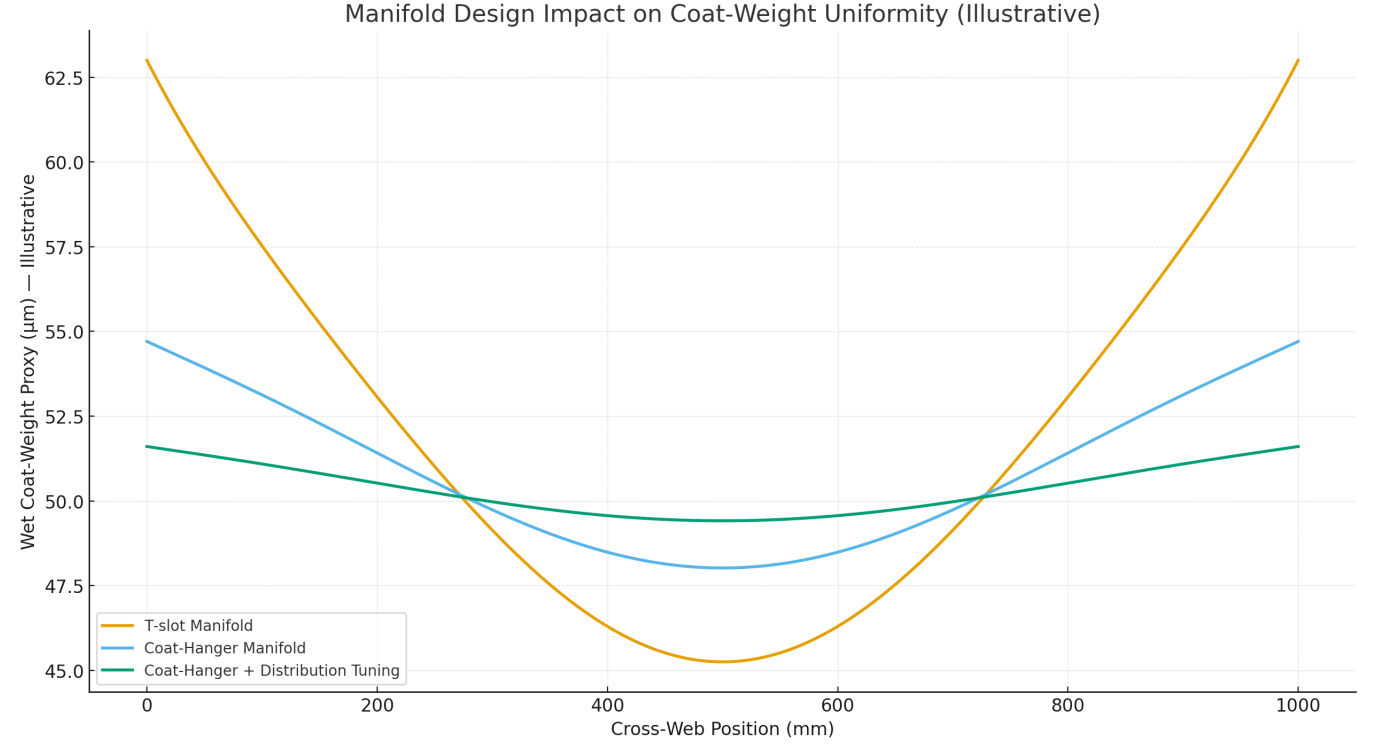
Manifold engineering. Compare T-slot vs coat-hanger manifolds; add distribution tuning (restrictor bars, adjustable rods) until cross-web slope < ±0.5 µm/100 mm at target coat weight. [2–4]
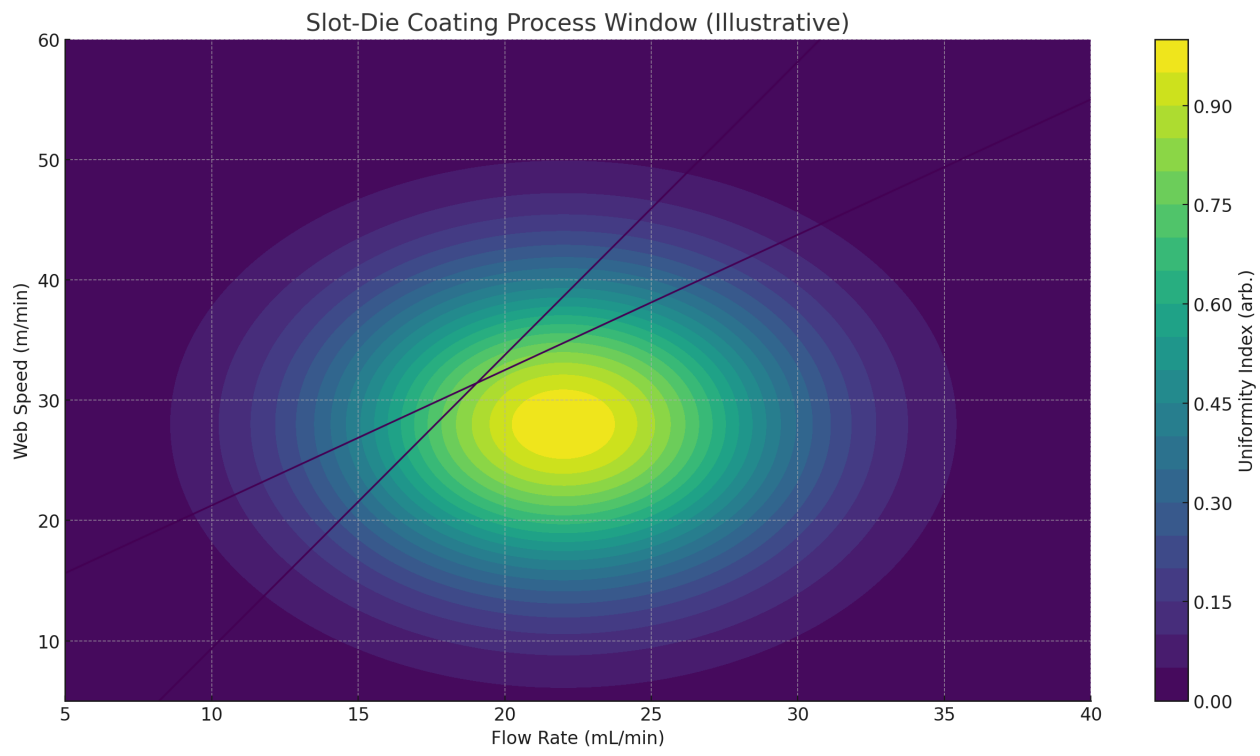
Process-window mapping. Build a grid of flow rate (mL/min) × web speed (m/min); label regions by defect modes (starvation/voids, ribbing/waves) and compute a Uniformity Index from inline data. [4–6]
CPP→CQA linkage. Map gap, lip temp, flow, speed, EBR vacuum, manifold ΔP to CQAs: thickness CV%, content uniformity (RSD%), residual moisture, curl, blocking ppm. [5–8]
Measures
Uniformity: cross-web thickness CV%, P–V (µm), lateral slope (µm/100 mm), assay RSD%.
Stability: starvation/ribbing incidence, web wander, die-lip build-up rate.
Downstream: curl (mm), blocking ppm, seal strength/opening force (N) after pouching. [4–9]
Results
Cross-web flattening: EBR and shims
Figure 1 shows a typical progression: no EBR/shims → prominent edge bead; EBR on reduces edge rise; EBR + lip shims yields a nearly flat profile with low sinusoidal residual. In practice this corresponds to CV% reduction (e.g., 3.2% → 1.6% → ≤1.0%). [3–6]
Flow–speed process window
Figure 2 maps a Uniformity Index; low-flow/high-speed corners starve, while high-flow/low-speed corners rib. A broad mid-band provides robust run conditions and changeover headroom. This window becomes the rate-increase roadmap during scale-up. [4–6]
Manifold design and distribution tuning
Figure 3 compares T-slot (edge-rich) with coat-hanger (more even). Adding distribution tuning (restrictors/shims) flattens the profile further, enabling higher solids% (dose via solids, not wet gap) without lateral tilt—key to curl control downstream. [2–5]
Discussion
Engineering rules that hold at scale
Chase dose with solids%, not wet gap. Larger gaps magnify edge bead and leveling time; higher solids% plus flat distribution holds geometry with less curl risk. [2–5]
EBR is a precision tool, not a crutch. Use vacuum/air-knife EBR to trim bead while keeping the bead-break line stable relative to web wander; pair with web guiding. [3–6]
Manifold first, shims second. Fix gross maldistribution at the manifold; use lip shims for fine trim. A tuned coat-hanger with mild shimming outperforms brute-force shimming of a poor manifold. [2–4]
Instrument before speed. Align inline thickness to lab (GR&R), then grow speed inside the process window using SPC/EWMA alarms on cross-web metrics. [5–8]
Keep lips clean & parallel. Thermal balance, lip polish, and periodic wipe plans prevent asymmetry from build-up.
Common pitfalls
Relying only on average coat-weight while ignoring cross-web slope.
Over-tight EBR that invades the product lane under wander, creating edge voids.
Increasing flow alone to fix ribbing—often worsens waves; adjust speed, viscosity, and impingement together. [4–6]
Conclusion
Slot-die ODF success is written in distribution and edges. By pairing a well-engineered coat-hanger manifold with EBR + lip-shim tuning and operating inside a mapped flow–speed window, teams can achieve ≤1% thickness CV, stable assay, and low-curl, pouch-ready films at commercial speed.
References
Slot-die fundamentals: gap, lip geometry, and flow distribution.
Manifold design (T-slot vs coat-hanger) and restrictor tuning for cross-web uniformity.
Edge-bead removal (vacuum/air-knife) setup and bead-break stability.
Flow–speed windows: starvation, ribbing, and leveling trade-offs.
QbD/PAT: inline thickness, vision, historian, GR&R, ALCOA+.
Solids% vs wet gap strategy and impact on curl and downstream packaging.
Web handling: guidance, tension, and die-lip maintenance for lateral stability.
Moisture/drying integration to preserve flatness post-coat.
Packaging implications of thickness/curl on seal strength and opening-force windows.