Author: Sihan Meng,Leyu Zhu,Pengcheng Shi
Affiliation: RSBM
Email: pengchengshi@biotechrs.com; pcspc9@gmail.com
Abstract
Building a reliable ODF line requires more than buying a coater and a packer. Reliability emerges when materials, equipment, process windows, packaging, analytics, and people systems are co-engineered and monitored against capability and availability targets. This paper distills practical design points for solution prep, slot-die coating, multi-zone drying, slitting/inspection, and sachet form–fill–seal, and links them to OEE and Cpk outcomes. We present (i) an end-to-end line architecture, (ii) an OEE waterfall that localizes loss drivers, and (iii) a capability heatmap for critical quality attributes (CQAs). The framework targets OEE ≥60–70%, Cpk ≥1.33 for thickness, disintegration, residual solvent, and seal strength, and packaging that locks low a_w and headspace O₂ [1–8].
Introduction
ODFs are thin polymeric films that disperse without water and demand tight control of microstructure, moisture, and flavor. From hydration and pH adjustment to slot-die coating, staged drying, and barrier packaging, small drifts can cascade into content-uniformity failures, slow disintegration, curl, and taste rollback. A reliable line therefore integrates robust unit ops with PAT, good packaging, and operator skill—and measures success via OEE and capability.
Methods
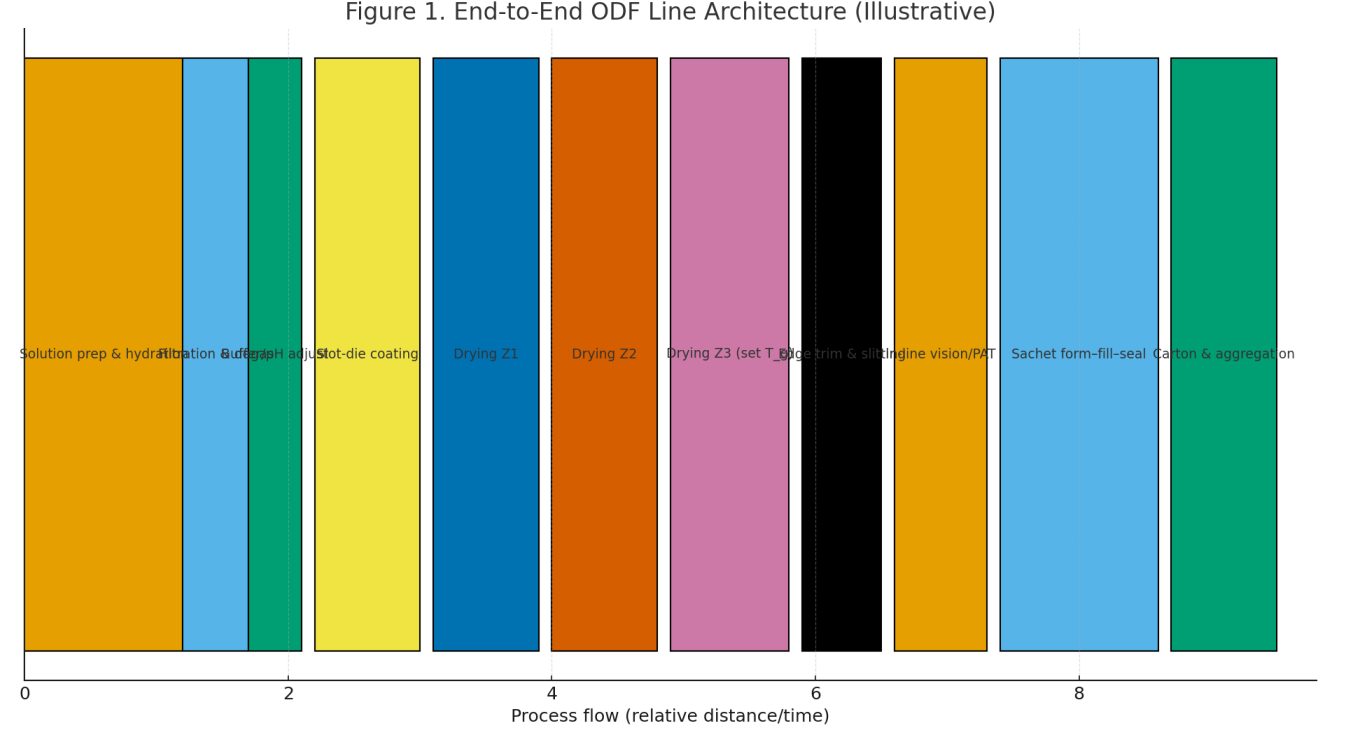
Line architecture (Fig. 1). Map unit operations, ensuring buffering tanks with controlled hydration, inline filtration/degas, pH/ionic control, slot-die with closed-loop gap, three-zone drying with controlled ΔT/ΔRH, slitting with vision/PAT, and high-barrier sachet packing.
Process windows. Define CPPs and ranges: solids %, viscosity (multi-shear), die gap, web tension, web speed, zone temperatures/ramps, residence time, residual solvent limit (ICH Q3C), and pack sealing window.
Analytics & controls. NIR thickness/moisture, inline O₂, vision for edge/defects/print/lot–expiry, SPC on peel/burst, and historian tags with alarm limits (ALCOA+).
Reliability program. CMMS-driven PM, critical spares (heater banks, seals, tension load cells), start-up checklists, and change-over SMED.
Measures. OEE waterfall decomposition; Cpk of thickness, disintegration, residual solvent, and seal strength; a_w, residual moisture, headspace O₂; first-hour scrap; deviation density; PPQ readiness.
Measures
Performance/CQA: disintegration ≤60 s; thickness RSD ≤5%; residual solvent within ICH Q3C; seal strength Cpk ≥1.33; a_w ≤0.3.
Reliability: OEE = Availability × Performance × Quality; first-hour scrap; MTBF/MTTR; change-over time.
Packaging: WVTR/OTR per ASTM F1249/F1927; peel/burst; channel-leak; opening force.
Governance: audit-trail completeness, CSV qualification of HMI/PLC/vision/PAT.
Results
Architecture clarity (Fig. 1). Visualizing the line highlights control points: pH buffering before coating, degassing to avoid air-entrapment streaks, Z3 drying to set T_g, and inline vision/PAT prior to sachet sealing.
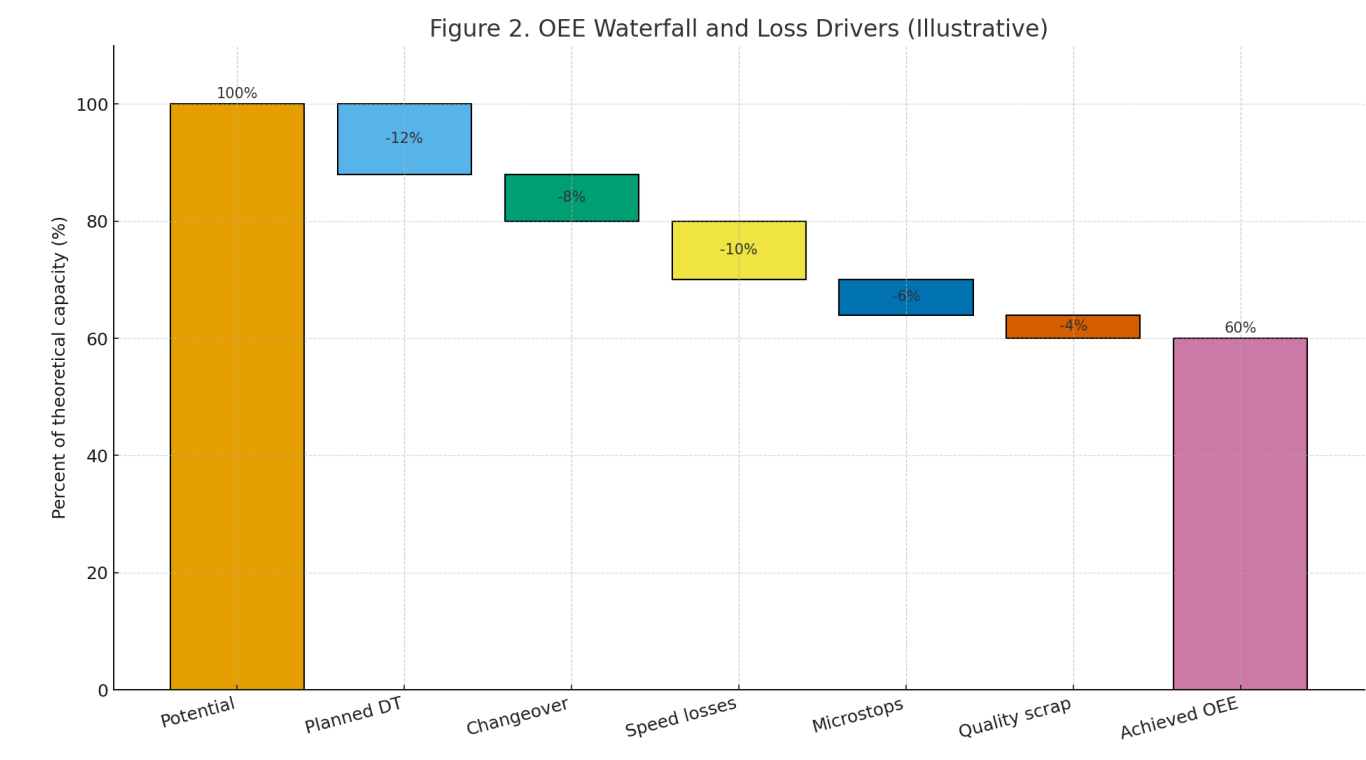
OEE localization (Fig. 2). In a typical baseline, planned downtime (−12%), changeover (−8%), speed loss (−10%), microstops (−6%), and quality scrap (−4%) reduce theoretical capacity to ~60% OEE. Priorities: SMED, ramp recipes, tension presets, and packer jaw planarity.
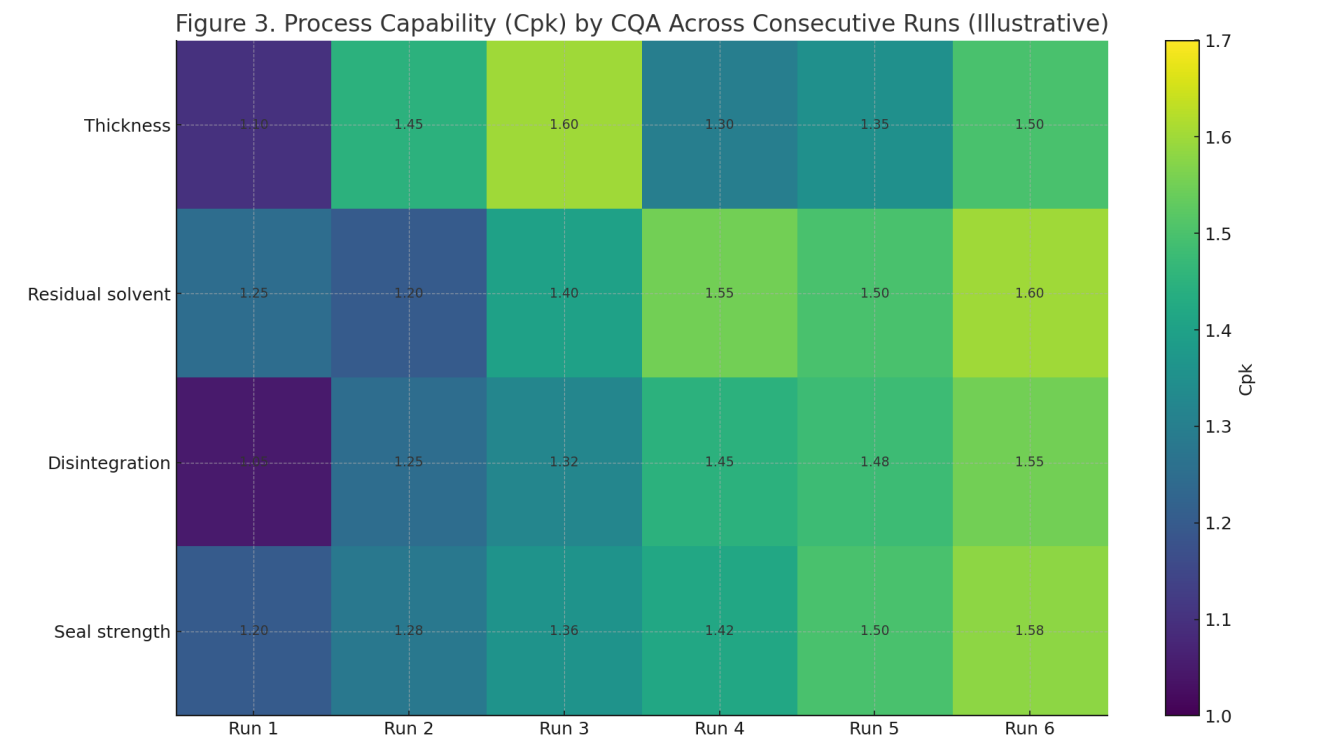
Capability maturation (Fig. 3). Across six runs, Cpk improved toward/above 1.33 for all CQAs as viscosity and drying ramps were tuned and die-lip alignment was locked. Residual-solvent and seal-strength capability responded fastest to targeted controls.
Discussion
Key points for a reliable ODF line
Solution prep matters: hydrate polymers with controlled shear and time; standardize ionic strength and pH for reproducible rheology.
Coating discipline: calibrate die gap and planarity; implement gauge maps for cross-web thickness; maintain closed-loop tension.
Drying as a recipe: staged ramps to avoid early skinning; couple NIR moisture with zone temperature profiles; verify residence time.
Packaging as protection: choose foil laminates for hygroscopic films; validate sealing windows and notch placement; monitor headspace O₂.
PAT + data integrity: lock historian tags and alarms; maintain ALCOA+ audit trails; review drift weekly.
Reliability routines: enforce start-up checklists, first-piece approval, spare kits, and PM cadence on heaters, blowers, and seal jaws.
People & changeovers: train for slot-die alignment and tension tuning; adopt SMED to cut changeover losses and stabilize OEE.
Trade-offs. Higher barrier increases material cost and stiffness but protects a_w; faster lines raise microstops unless tension/vision are tuned; richer taste systems can slow drying and raise residual solvents—requiring recipe changes.
Conclusion
A reliable ODF production line is a system: robust hydration and rheology control, precise slot-die and tension governance, recipe-driven drying, barrier-competent packaging, and vigilant analytics. Measured through OEE and Cpk, this system delivers fast disintegration, stable taste, and audit-ready performance. With the control plan laid out here, teams can progress from engineering runs to PPQ with fewer deviations and predictable throughput.
References
[1] ICH Q8–Q10: pharmaceutical development, risk management, and PQS.
[2] EU-GMP Annex 15 & FDA Process Validation guidance (Stage 1–3).
[3] USP/Ph. Eur. chapters on orodispersible films, content uniformity, disintegration.
[4] Thin-film coating literature on slot-die gap/tension control and cross-web uniformity.
[5] Process analytical technology for moisture/thickness and inline vision inspection.
[6] ICH Q3C residual solvent limits and drying strategy implications.
[7] ASTM F1249/F1927 barrier tests; seal strength and leak-test standards.
[8] Reliability engineering/SMED resources for OEE improvement in packaging lines.